Sarah Nirenberg
February 13, 2020
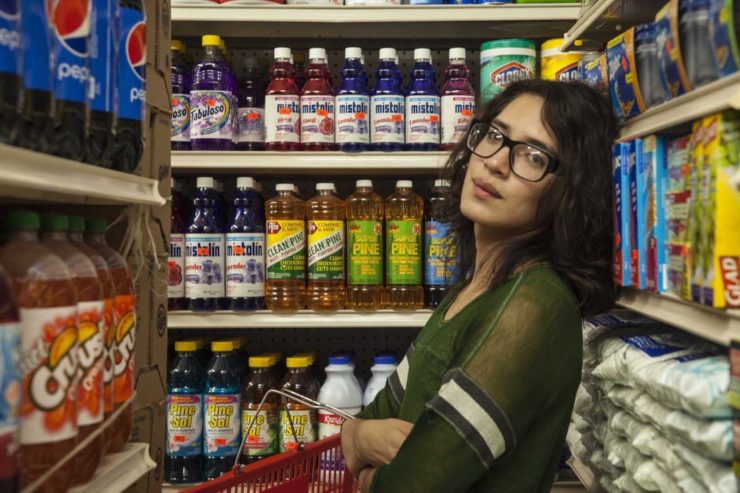
The Garden Left Behind, written and directed by Flavio Alves, is a film that focuses on the trials and tribulations of a person trying to transition. Tina Carrera, portrayed by Carlie Guevara, is an undocumented immigrant living in New York City with her grandmother, Eliana, who is played by Miriam Cruz. Tina works as a cab driver to support herself and her grandmother, and her leftover money is saved for her transition.
By following the life of Tina, the viewers get a sense of what she thinks of herself and what others think of her. It is clear that Tina tries to have a positive outlook on life but is being constantly challenged by people and events in her life. Jason, played by Alex Kruz, is Tina’s boyfriend of two years but is embarrassed to be seen with her in public and seems to just use her for sex. In my opinion, I think that Jason is embarrassed to be with Tina due to societal norms of what a “normal” couple should look like. Although Tina loves Jason, the most important relationship she has is with her grandmother, Eliana. Eliana accepts Tina’s decision to transition, but it is clear that she does not understand the decision since she is only able to call Tina by her given name, Antonio. Eliana has a limited understanding of the world due to her binary thinking, but Tina’s transgender friends are able to help Eliana deepen her understanding of the world and the transgender community.
Tina is extremely disadvantaged by her different roles as she is an undocumented transgender immigrant with poor socioeconomic status. She occupies many different positions that sum together to create a greater disadvantage than they would individually, which is known as intersectionality. For example, because she is an undocumented immigrant, she faces more hurdles when it comes to getting a stable job, not to mention the disadvantage she already has being a woman, nonetheless a transgender woman. In addition, Tina also struggles with feeling like an outsider in the transgender community as she has not transitioned yet, which is evident when she is hesitant to become an activist for the community after a transgender woman is subject to police brutality. Tina is able to overcome this challenge by becoming an activist and a leading voice for the transgender community as they organize marches and interviews to get justice and raise awareness about the institutional discrimination towards the transgender community.
Chris, played by Anthony Abdo, is an interesting character in the film. Chris is a cashier who at first comes off as a creepy man who is somewhat fascinated with Tina. It is clear when the audience gets to know him that he is confused and is always being challenged by his friends, who refer to him with derogatory language, possibly because of his outwards appearance. Throughout the film, Chris develops feelings for Tina, as he tries to call her on the phone and talk to her in person. At the end of the film it is apparent that Chris is not comfortable with his feelings towards Tina and I think this can be explained by a quote from Being In Question that goes as follows, “Heteronormativity functions as a form of public comfort by allowing bodies to extend into spaces that have already taken their shape.” (Ahmed 123) Chris sees the way his friends treat Tina, and how nonconforming people are treated by society in general and would rather be in a safe and comfortable space as heterosexual than deal with the societal consequences of straying from this straight line that society tries to keep us in.
Gender roles and gender expression is a big factor in this film. As Tina has not gone through the transition process, she expresses herself through her clothes, hairstyle, and body shape. Tina wears “female” clothing such as bras, has long hair, and is seen several times looking at her body in the mirror trying to make it look as “feminine” as possible. Of course, these are all characteristics that society has determined are feminine and expects females to conform to. Chris does not conform to his gender roles, as boys are expected to have short hair, but Chris has long hair, similar to Tina’s. In the article Signs of Gender, Sally Raskoff says, “People’s whose outward appearance conforms to the gender norms are not challenged.” Throughout the film we see how Chris’ friends constantly challenging him becomes an increasing struggle for him, and eventually he shaves off all his hair to conform to gender norms. This shows how normativity controls our lives, sometimes without us even realizing it.
The end of the film is shocking to the audience, as the film makes it seem as if there is a budding relationship, or at least an understanding, between Tina and Chris. When Chris’ friends confront Tina as she is walking down the street, Chris gets out of the car and the audience thinks he is going to stand up for her and do something in her favour. However, he brutally assaults her with a baseball bat, killing her. Although this scene was hard to watch, I think it was an extremely important scene in this film because it emphasizes the harsh reality for many trans people, or non-conforming people in general. Speaking on my own behalf, as a cisgender woman, it is comfortable to naively think that there is a happy ending for everyone and that the world is just, however that is not the case for most people. Society is constantly forcing people not to deviate from the straight line, and when those people try to make space for themselves, there are unfortunately societal consequences, including some as drastic as portrayed in The Garden Left Behind.
One of the most special parts about The Garden Left Behind is the representation. All the transgender characters are played by transgender actors, which is very powerful to viewers. The article Negotiating Fandom discusses the importance of representation because proper representation is important because it shapes the way that a certain group of people are interpreted by the other people watching. It also allows the viewers in the community of those being represented to take ownership over the characters and the way those characters are presented to the audience (Jenkins 384).
Overall, The Garden Left Behind is a touching film that tackles the topics of the transgender community and immigration through the first-person perspective and proper representation that really resonates with the audience.
Word Count: 1084
Works Cited
Raskoff, Sally. “Signs of Gender.” Everyday Sociology, W.W Norton & Company, Inc, https://www.everydaysociologyblog.com/2017/03/signs-of-gender.html#more. February 12, 2020
Ahmed, Sara. “Being in Question.” Living a Feminist Life, Duke University Press, 2017, pp. 11-134.
Jenkins, Henry. Negotiating Fandom: The Politics of Racebending. New York, Routledge, 2017, pp. 383-393
 GNDS 125 - 001
I thought this film review was extremely interesting. The fact that I saw this same film, and took such a different approach in my analysis is very alluring. Although we both had unique analyses and understandings of The Garden Left Behind, it is clear that we took the same message away from the film: Tina must be understood based on her cumulative aspects of identity.
-Madison Ziedenberg
LikeLike